Still in Progress: The Case for Keeping Your Best Work Beautifully Unfinished
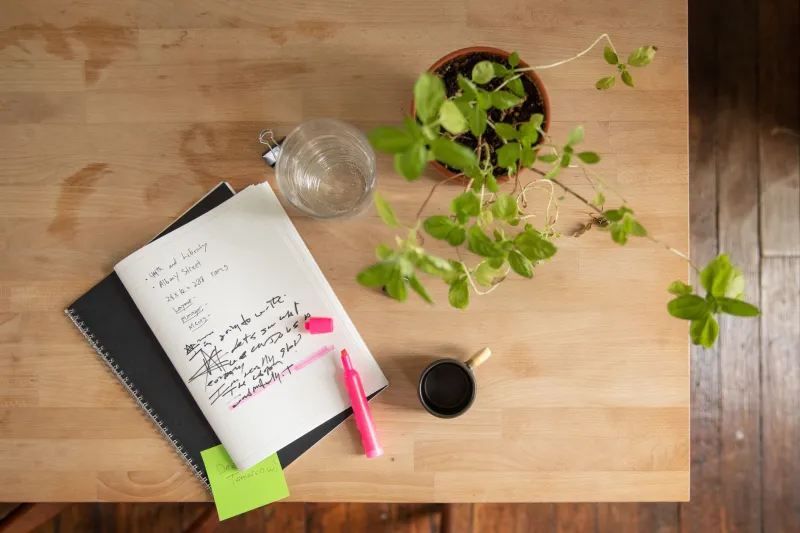
There's a notebook on Priya Sharma's kitchen table that she's been writing in for eleven years. It's not a journal, exactly. It's not a novel. She describes it as "a conversation I'm having with myself that I'm not ready to end." The pages are dense with half-formed ideas, sketched-out characters, fragments of dialogue, and questions she returns to again and again without ever resolving them. She's a creative director in Chicago with a full career and a full life. She is not, by any reasonable measure, a procrastinator.
And yet the notebook remains open. Deliberately.
"Finishing it would close something," she says. "I don't want it closed."
This is a feeling a surprising number of thoughtful, high-functioning people quietly understand — the sense that their most important work isn't stalled so much as held. Kept warm. Deliberately left in a state of becoming.
The Myth of the Finished Thing
We live inside a culture that treats completion like a moral virtue. Finish what you start. Ship the product. Cross it off the list. There's an entire productivity industrial complex built around the dopamine hit of the done — the closed loop, the checked box, the launched thing. And sure, there's real satisfaction in that. Nobody's arguing otherwise.
But somewhere along the way, we started treating incompleteness as a problem to be solved rather than a state worth examining. We conflated unfinished with failed, and in doing so, we lost the ability to recognize when staying in the middle is actually the most honest place to be.
Psychologists have a name for the pull of unfinished things: the Zeigarnik effect. Named after Soviet psychologist Bluma Zeigarnik, the theory holds that our brains hold incomplete tasks in a kind of active memory — they hum in the background, staying alive in ways that finished things simply don't. We remember interrupted experiences more vividly than completed ones. There's cognitive energy in the open loop.
For some people, that's a source of anxiety. For others — the ones we're talking about here — it's a source of fuel.
What Lives in the Margins
Ask around among creative people, makers, writers, and thinkers, and you'll find an unexpected consistency: the projects they care most deeply about are rarely the ones they've finished. They're the ones living in the margins. The half-built cabinet in the garage. The essay that's been "almost done" for three years. The business idea that gets revisited every winter. The painting that's been sitting on the easel with one corner left untouched.
Marco Ellis, a furniture maker based in Portland, Oregon, has a rocking chair in his studio he started in 2019. He knows exactly how to finish it. He has the wood, the tools, the skill. He just hasn't.
"Every time I come back to it, I learn something," he says. "It's become this ongoing teacher. If I finished it, it would just be a chair."
There's something profound in that distinction. The finished object is static. The unfinished one keeps asking questions.
This isn't romanticizing avoidance. The difference between productive incompleteness and plain old procrastination is intention — and, honestly, self-awareness. The people who live generatively in the unfinished understand why something remains open. They're not avoiding the work. They're protecting the aliveness of it.
Permission to Stay in the Middle
Our obsession with finished things is partly cultural, partly generational. Many of us were raised with a fairly transactional relationship to effort: you do the work, you get the result, you move on. The idea that the doing might be the point — that the process could be more valuable than the product — doesn't come naturally in a society that measures success by output.
But the most interesting people tend to figure this out eventually. They stop asking "when will this be done?" and start asking "what is this still teaching me?"
Writer and essayist Dana Chou has been working on the same collection of personal essays for six years. She's published extensively in that time — other things, finished things — but this particular project stays open.
"I think I'm afraid that finishing it will mean I've said everything I have to say about that period of my life," she admits. "And I'm not ready to be done with it yet. The essays are how I keep processing. They're how I stay in conversation with my own history."
That's not a failure of follow-through. That's emotional intelligence dressed up as a writing project.
The Generative Power of Not Knowing
There's a concept in design thinking called "staying in the problem space" — resisting the urge to jump to solutions before you've fully understood what you're actually dealing with. The best designers, engineers, and creative thinkers know how to sit with uncertainty, to resist the seduction of premature closure.
The same principle applies to the projects we carry in our personal lives. The memoir you're not sure you want anyone to read. The career pivot you're still researching three years in. The relationship with your estranged sibling that you've been slowly, carefully tending without forcing a resolution.
These aren't failures. They're active processes. And the people who understand that tend to have richer inner lives for it.
This is worth saying plainly: not everything that matters gets finished. Some of the most important work of your life might be the stuff that never makes it to the final form. The thinking you did. The drafts you wrote and abandoned. The ideas you let live in your head for years before they quietly transformed into something else entirely.
What to Do With Your Own Open Loops
If you've got a project — creative, personal, professional — that's been sitting unfinished for a while, it might be worth asking a few honest questions before you either force it to completion or abandon it altogether.
First: does it still have energy? Does it still feel alive when you come back to it, or has it gone cold? There's a difference between something that's deliberately held open and something that's just been forgotten.
Second: what would finishing it actually give you? Sometimes the answer is real and important — closure, income, a concrete thing to share with the world. But sometimes, if you're honest, the answer is just relief from the guilt of having something unfinished. And that's probably not a good enough reason to rush it.
Third: are you learning anything from it? Priya's notebook, Marco's rocking chair, Dana's essays — they all share this quality. They're still generating something. Still producing insight, even without producing a finished product.
If your unfinished thing is still teaching you, still asking questions you find interesting, still pulling you back — maybe it's not unfinished at all. Maybe it's just doing exactly what it's supposed to do.
The List That Stays Open
There's a certain kind of person who keeps a list of projects they'll probably never finish. And they're not ashamed of it. It's not a list of failures. It's more like a map of who they are — all the things they've cared enough about to start, all the directions their curiosity has pulled them, all the open questions they've decided are worth living inside.
That list is a portrait. And portraits, by their nature, are never really done.
Maybe the most honest thing you can do with your most meaningful work is let it stay in progress. Not because you're avoiding the hard part, but because you're smart enough to know that the hard part — the alive, uncertain, generative middle — is exactly where you want to be.